Download Executive Briefing PDF File: Mechanisms, Variables, and Limitations of Laser Tattoo Removal
Laser tattoo removal has become an established method for reducing or removing unwanted tattoos. Modern laser technology can target many types of tattoo pigment while limiting damage to surrounding skin. However, one of the most common questions people ask before beginning treatment is why some tattoos disappear relatively easily while others require many sessions or remain partially visible.
The answer involves several factors, including tattoo ink composition, pigment color, ink depth, tattoo age, skin characteristics, and the body’s natural response to treatment.
Understanding these differences helps explain why laser tattoo removal is not identical for every person or every tattoo.
How Laser Tattoo Removal Works
Laser tattoo removal uses concentrated pulses of light energy to target tattoo pigment beneath the skin.
Tattoo ink is deposited primarily within the dermis, the layer of skin beneath the epidermis. Because the pigment is embedded within this deeper layer, ordinary skin renewal does not eliminate the tattoo.
During laser treatment, selected wavelengths of light are absorbed by tattoo pigment. Rapid energy absorption produces effects that can fragment pigment particles into smaller pieces.
These fragments may then be processed by immune cells and gradually transported away from the treated area through the body’s natural clearance mechanisms.
This process takes time. Tattoo fading generally occurs over weeks and months rather than immediately after a treatment session.
Different tattoos respond differently because their pigments, physical characteristics, and surrounding tissues are not identical.
- Tattoo Ink Color Influences Removal Difficulty
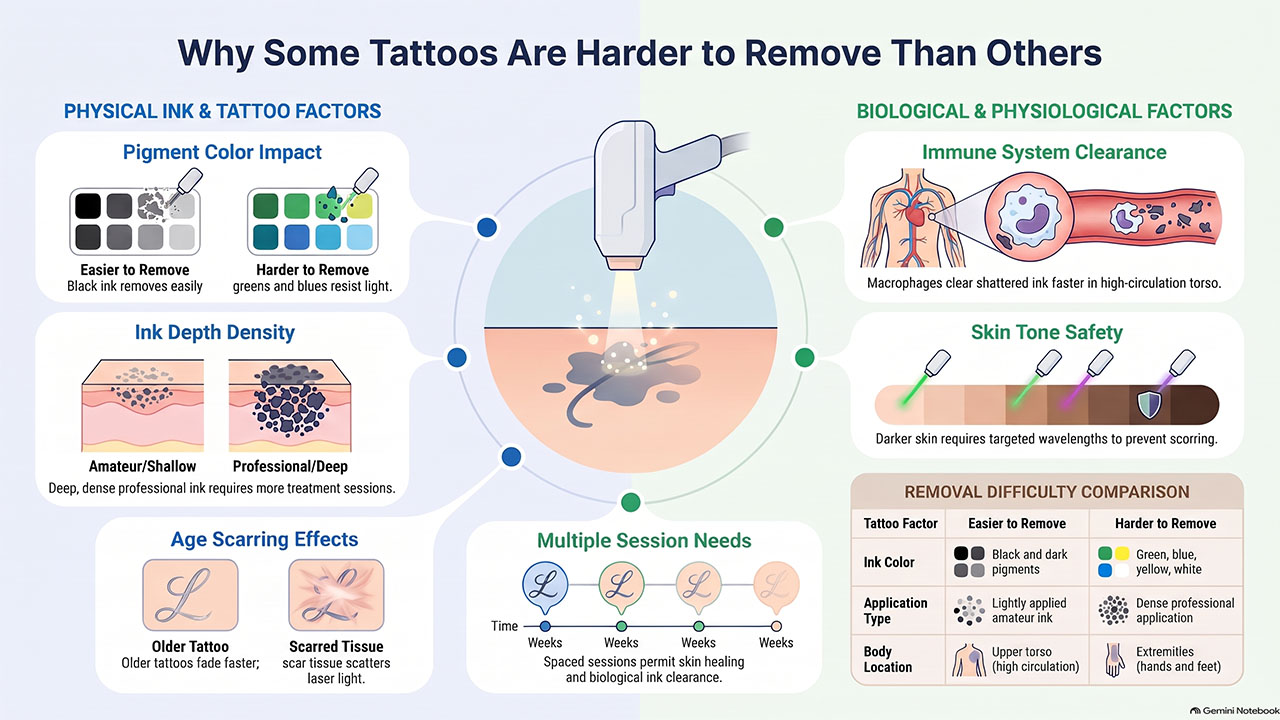
One of the most important factors affecting laser tattoo removal is the color of the pigment.
Different tattoo pigments absorb different wavelengths of light. For laser treatment to work effectively, sufficient energy must reach and interact with the targeted pigment.
Black and Dark Tattoo Ink
Black tattoo ink generally absorbs light across a broad range of wavelengths, making it responsive to commonly used tattoo removal lasers.
For this reason, black tattoos are often more straightforward to treat than multicolored tattoos.
However, even a black tattoo may be difficult to remove if the pigment is deeply embedded, densely concentrated, or associated with scar tissue.
Red, Orange, and Yellow Pigments
Red pigments can often respond to appropriately selected laser wavelengths, but treatment effectiveness varies with the pigment formulation.
Orange and yellow pigments may be more challenging because some formulations absorb available laser wavelengths less efficiently.
Green and Blue Tattoo Ink
Green and certain blue pigments can be particularly resistant to some laser systems.
Successful treatment may require wavelengths specifically suited to these colors.
The availability of appropriate laser technology is therefore an important consideration when treating multicolored tattoos.
White and Flesh-Colored Pigments
White, flesh-colored, and certain cosmetic tattoo pigments present additional challenges.
Some contain compounds that can darken following laser exposure. This phenomenon is sometimes called paradoxical pigment darkening.
A qualified laser professional should carefully evaluate these tattoos before treatment.
The Importance of Laser Technology
Modern picosecond laser systems, such as the Quanta Discovery PICO used at North Bay Laser & Skin Care Center, are designed to deliver extremely short pulses of laser energy to tattoo pigment.
The Discovery PICO series offers different wavelength configurations to address a variety of pigment colors. Selecting the appropriate wavelength is an important part of developing an individualized tattoo removal treatment plan.
Because tattoo pigments respond differently to laser energy, the technology used and the characteristics of the individual tattoo both influence treatment outcomes.
- The Depth of Tattoo Ink Affects Laser Removal
Tattoo pigment is not always deposited at a uniform depth.
Professional tattoo artists generally aim to place pigment within the dermis, but the precise depth can vary depending on tattooing technique, skin characteristics, and the area being tattooed.
Pigment located deeper within the skin may receive less effective laser energy because light is scattered and absorbed as it passes through tissue.
Deeper pigment can therefore be more difficult to fragment.
Uneven pigment placement can also cause different sections of the same tattoo to fade at different rates.
This explains why a tattoo may become noticeably lighter in some areas while retaining darker patches elsewhere.
- Professional Tattoos Often Contain More Pigment
Professional and amateur tattoos frequently differ in pigment density and consistency.
Professional tattoos are commonly created using specialized equipment designed to deposit pigment evenly and produce long-lasting color.
As a result, they may contain substantial concentrations of ink within the dermis.
Dense pigment deposits can require multiple treatment sessions because a single laser treatment may not effectively fragment all the pigment present.
Amateur tattoos sometimes contain less pigment and may be placed less consistently within the skin.
Consequently, certain amateur tattoos may respond more quickly to laser removal.
However, this is not a universal rule. An amateur tattoo with unusually deep pigment placement can still be difficult to treat.
The amount, depth, and composition of the pigment matter more than whether the tattoo was professionally applied.
- Tattoo Age Can Influence Removal Results
Older tattoos are sometimes easier to remove than newer tattoos.
Over time, tattoos may undergo gradual changes as pigment particles are redistributed, processed by immune cells, or reduced through natural biological processes.
Sun exposure and other environmental factors may also contribute to visible fading.
An older tattoo that has already lost some of its original pigment intensity may require less treatment than a newer tattoo containing dense, vibrant ink.
However, tattoo age alone does not determine removal difficulty.
Some decades-old tattoos retain substantial pigment, while newer tattoos may respond favorably to treatment.
Tattoo age is best considered alongside pigment density, color, depth, and skin condition.
- Tattoo Location Can Affect Pigment Clearance
The location of a tattoo on the body can influence how it responds to laser treatment.
Areas with relatively favorable circulation and lymphatic drainage may clear fragmented pigment more efficiently than certain areas farther from the center of the body.
For example, tattoos on the upper torso may sometimes fade more readily than tattoos on the hands, feet, or lower extremities.
However, individual results vary considerably.
Skin thickness, local circulation, tattoo density, and the body’s immune response can all influence the treatment process.
Tattoo location is one factor among many rather than a reliable predictor of the exact number of sessions required.
- The Body’s Immune System Plays an Important Role
Laser technology initiates the fragmentation of tattoo pigment, but the body’s biological processes contribute to the gradual removal of fragmented particles.
Immune cells, including macrophages, interact with tattoo pigment in the skin.
Following laser treatment, smaller pigment fragments may be taken up by these cells and transported through lymphatic pathways.
The effectiveness and speed of this process can vary between individuals.
Factors such as general health, local tissue conditions, and individual immune responses may influence how quickly visible fading occurs.
This is one reason two people with similar tattoos may experience different treatment outcomes.
Laser tattoo removal is not simply a matter of applying enough energy to erase pigment. It involves an interaction between laser technology, tattoo characteristics, and the body’s natural biological response.
- Scar Tissue Can Make Tattoo Removal More Difficult
Some tattoos contain scar tissue resulting from the original tattooing process, previous injury, or earlier removal attempts.
Scar tissue can alter the structure of the skin and affect how laser energy travels through the treated area.
It may also complicate the appearance of fading because changes in skin texture can remain visible even after pigment has been reduced.
In certain cases, scar tissue can make treatment more challenging and increase the importance of carefully selected laser settings.
It is also important to distinguish between residual tattoo pigment and permanent changes in skin texture.
Even when substantial pigment removal is achieved, preexisting scarring may remain.
- Skin Tone Influences Laser Treatment Planning
Skin tone is another important consideration in laser tattoo removal.
Melanin, the pigment responsible for much of the skin’s natural coloration, can absorb some of the same laser wavelengths used to target tattoo ink.
When excessive laser energy is absorbed by surrounding skin rather than the tattoo pigment, the risk of unwanted effects may increase.
Potential complications include temporary or persistent changes in pigmentation, blistering, and scarring.
For individuals with darker skin tones, laser professionals may select different wavelengths, energy settings, and treatment intervals to reduce these risks.
Longer wavelengths, including 1064 nm in appropriately selected systems, are often useful for treating certain dark tattoo pigments in darker skin types because they are less strongly absorbed by epidermal melanin than some shorter wavelengths.
The goal is to deliver effective energy to the tattoo pigment while protecting the surrounding skin.
Personalized treatment planning is therefore essential.
- Why Multiple Laser Tattoo Removal Sessions Are Necessary
A common misconception is that laser tattoo removal should eliminate an entire tattoo during a single appointment.
In reality, most tattoos require multiple treatment sessions.
Several factors explain why.
First, tattoo pigment may exist at different depths and concentrations within the skin.
Second, the amount of energy that can safely be delivered during a single session is limited by the need to protect surrounding tissue.
Third, the body requires time to process and clear fragmented pigment after treatment.
Allowing adequate time between sessions gives the skin an opportunity to recover and permits continued pigment clearance.
Treatment intervals are commonly measured in weeks, with the appropriate schedule determined by the treating professional.
Attempting to accelerate the process through excessively frequent treatment does not necessarily improve results and may increase the risk of skin injury.
- Why Some Tattoos Cannot Be Completely Removed
Although modern laser technology has substantially improved tattoo removal, complete elimination of every tattoo cannot be guaranteed.
Certain pigments may respond poorly to available wavelengths.
Deeply embedded ink, unusually dense pigment deposits, scar tissue, and individual biological differences can also limit the final result.
Some tattoos fade until they are barely noticeable, while others retain visible pigment even after an extensive treatment series.
The distinction between significant fading and complete removal is important.
For individuals considering tattoo removal, realistic expectations are an essential part of the consultation process.
A qualified provider can evaluate the tattoo and discuss the likely challenges, potential risks, and reasonable treatment goals.
Personalized Laser Tattoo Removal in Santa Rosa, California
Because every tattoo is different, effective laser tattoo removal begins with an individualized assessment.
At North Bay Laser & Skin Care Center in Santa Rosa, California, patients can discuss the characteristics of their tattoos and the factors that may influence treatment.
Important considerations include tattoo color, pigment density, location, skin tone, previous treatment history, and individual goals.
Understanding these factors helps patients approach laser tattoo removal with realistic expectations and a clearer appreciation of why treatment plans vary.
Conclusion: Every Tattoo Presents a Different Removal Challenge
Some tattoos are harder to remove because of the interaction between pigment characteristics, tattoo placement, skin biology, and laser technology.
Black ink may respond more readily than certain colored pigments. Dense professional tattoos may require more treatment than lightly pigmented tattoos. Deep ink placement, scar tissue, skin tone, and the body’s natural pigment-clearance processes can all influence the outcome.
No single characteristic determines whether a tattoo can be completely removed.
Instead, successful treatment planning requires evaluating the tattoo as a whole and selecting an approach appropriate for the individual.
The most important principle is that laser tattoo removal is a gradual, personalized process rather than an instant erasure technique.
Understanding why tattoos respond differently allows patients to make more informed decisions and develop realistic expectations before beginning treatment.
Why are some tattoos harder to remove than others?
Some tattoos are harder to remove because of differences in ink color, pigment density, tattoo depth, location, and individual skin characteristics. The type of laser technology used and the body’s ability to gradually clear fragmented pigment also influence treatment results.
What tattoo ink colors are the hardest to remove?
Green, blue, yellow, and certain lighter-colored pigments can be more challenging to remove than black ink. Different colors absorb different laser wavelengths, and some pigments respond poorly to commonly used systems. White and flesh-colored pigments may also darken after laser exposure, making careful evaluation especially important.
Are professional tattoos harder to remove than amateur tattoos?
Professional tattoos are often more difficult to remove because they typically contain greater pigment density and more consistent ink placement. Amateur tattoos may contain less pigment, although deeply embedded or unevenly applied ink can still present challenges.
Are older tattoos easier to remove than newer tattoos?
Older tattoos may be easier to remove because some pigment can gradually fade or change over time. However, tattoo age alone does not determine treatment difficulty. Ink composition, pigment density, depth, and skin characteristics remain important factors.
Does tattoo location affect laser removal results?
Yes. Tattoo location can influence how quickly fragmented pigment is cleared. Tattoos on areas with relatively favorable circulation and lymphatic drainage may sometimes respond more readily than tattoos on the hands, feet, or lower extremities. Individual results vary.
Can a deeply embedded tattoo be completely removed?
Deeply embedded tattoo pigment may require additional treatment sessions because laser energy must reach pigment located farther beneath the skin’s surface. Significant fading may be possible, but complete removal cannot be guaranteed.
Why does laser tattoo removal require multiple sessions?
Most tattoos require multiple sessions because pigment is distributed at different depths and concentrations within the skin. Laser treatments fragment pigment, while the body gradually processes and clears some of those fragments. Time between sessions also allows the treated skin to recover.
Can laser tattoo removal work on darker skin tones?
Laser tattoo removal can be performed on many darker skin tones, but treatment requires careful selection of laser wavelengths and settings. Because melanin can absorb laser energy, personalized treatment planning is important to reduce the risk of pigmentation changes and other complications.
Does picosecond laser technology help remove difficult tattoos?
Picosecond lasers deliver extremely short pulses of energy that can fragment tattoo pigment. Systems such as the Quanta Discovery PICO series offer wavelength configurations designed to address different pigment characteristics. Results still depend on tattoo color, ink density, skin characteristics, and the specific equipment configuration used.
Can every tattoo be completely removed with laser treatment?
No. Although modern laser technology can substantially fade many tattoos, complete removal is not guaranteed. Certain pigments, deep ink placement, scar tissue, and individual biological differences may limit the final result. A professional evaluation can help establish realistic expectations.