
Laser hair removal has become a popular option for people who want to reduce unwanted hair without the ongoing maintenance of shaving, waxing, or plucking. One of the most common questions patients ask before beginning treatment is simple: How many laser hair removal sessions will I need?
The answer depends on several factors, including the treatment area, hair growth cycle, hair color, skin characteristics, and individual response to laser energy. Although many people achieve significant hair reduction after a series of treatments, there is no universal schedule that works for everyone.
Understanding why multiple sessions are necessary can help patients establish realistic expectations and make informed decisions about their treatment.
Why Laser Hair Removal Requires Multiple Sessions
Laser hair removal works by directing concentrated light energy toward pigment within the hair. When absorbed, this energy converts to heat and damages structures involved in hair growth, reducing the follicle’s ability to produce hair.
However, not every hair follicle is equally responsive during a treatment session.
Hair follicles naturally move through different stages of growth, and laser treatment is generally most effective when hair is actively growing and remains connected to structures that can be affected by the laser.
Because only a portion of follicles are in this favorable stage at any given time, a single appointment cannot effectively treat every hair in an area.
Multiple sessions allow the provider to target additional follicles as they enter the appropriate growth phase.
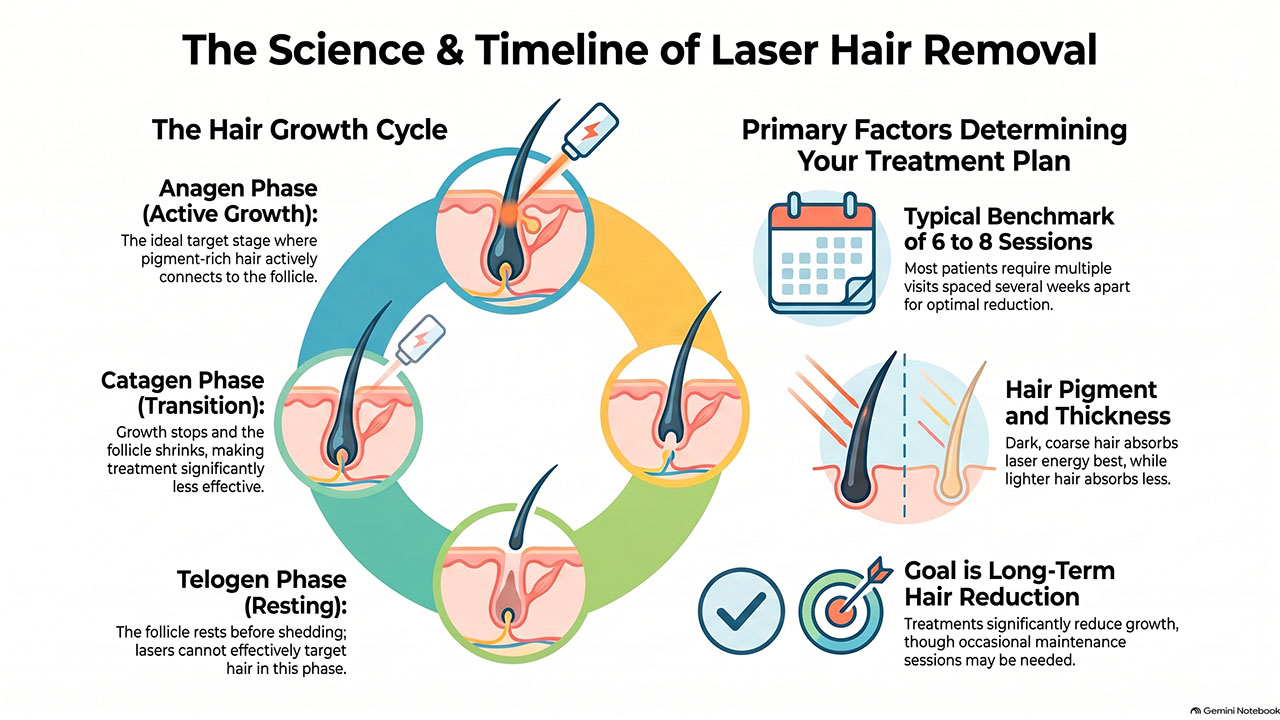
Understanding the Three Stages of Hair Growth
The hair growth cycle helps explain why treatment schedules extend over several months.
Anagen: The Active Growth Phase
During anagen, the hair is actively growing. This is generally the most favorable stage for laser hair removal because the hair contains pigment and is connected to the follicular structures involved in growth.
Catagen: The Transitional Phase
Catagen is a relatively brief period when active hair growth stops and the follicle begins transitioning toward its resting state. Hair in this phase is typically less responsive to laser treatment.
Telogen: The Resting Phase
During telogen, the follicle is resting before the hair eventually sheds and another growth cycle begins. Laser treatment is generally less effective during this stage.
Different follicles move through these phases independently. Even hairs located close together may be at different stages of growth.
This natural variation is one of the principal reasons laser hair removal requires a series of appointments.
How Many Laser Hair Removal Treatments Are Typically Recommended?
Many patients begin with a series of approximately six to eight laser hair removal sessions, although some need fewer or additional treatments.
This range is a general planning estimate rather than a guaranteed number.
The appropriate treatment schedule depends on how individual follicles respond, the location of unwanted hair, and the characteristics of the hair being treated.
Some patients notice reduced hair growth after their first few appointments. Others experience a more gradual change as successive treatments affect additional follicles.
The objective is progressive, long-term hair reduction rather than immediate elimination of every visible hair.
An experienced provider can evaluate treatment progress and determine whether additional sessions may be beneficial.
Why the Treatment Area Makes a Difference
Hair growth patterns vary considerably throughout the body.
Areas such as the underarms, legs, bikini line, back, and face can differ in hair density, growth-cycle timing, and hormonal influences.
For example, facial hair may be particularly influenced by hormonal activity, while hair on the legs may follow different growth patterns.
These differences can affect both the number of sessions required and the interval between appointments.
Larger treatment areas do not necessarily require more sessions simply because of their size. The biological characteristics of the follicles are often more important than the physical dimensions of the area.
For this reason, treatment recommendations should be based on the specific body area rather than a single standardized schedule.
How Hair Color and Thickness Influence Results
The amount of pigment within the hair is another important factor.
Laser hair removal relies on the absorption of light energy by melanin, the pigment responsible for much of the hair’s color.
Dark, coarse hair generally absorbs laser energy more effectively than very light or fine hair.
As a result, patients with dark, coarse hair often respond well to treatment, although individual outcomes still vary.
Blonde, red, gray, and white hairs may respond poorly because they contain less of the pigment targeted by conventional hair removal lasers.
Hair thickness also influences how effectively energy is delivered to the follicle.
These characteristics help explain why two patients receiving treatment in the same area may require different numbers of sessions.
Does Skin Tone Affect the Treatment Schedule?
Skin tone is an important consideration when selecting laser technology and treatment settings.
Because melanin is present in both hair and skin, the provider must choose settings that effectively target the follicle while limiting unwanted heating of surrounding skin.
Modern laser systems offer different wavelengths and adjustable parameters that can accommodate a range of skin tones when used appropriately.
Patients with darker skin tones may benefit from particular wavelengths and carefully selected settings designed to improve treatment safety.
However, skin tone alone does not determine the number of sessions needed.
The treatment schedule must account for the combination of skin characteristics, hair pigmentation, treatment area, and individual response.
Personalized settings are essential for balancing effectiveness with skin protection.
Why Laser Hair Removal Appointments Are Spaced Apart
Patients sometimes wonder whether scheduling treatments closer together will produce faster results.
In most cases, more frequent appointments do not necessarily improve effectiveness.
Laser hair removal is timed around the biological growth cycle. If sessions occur before enough additional follicles enter a favorable growth stage, the treatment may provide limited additional benefit.
Appointments are commonly spaced several weeks apart, with the interval varying according to the treatment area and provider’s assessment.
Facial areas may follow a different schedule from the legs or back.
Allowing sufficient time between appointments helps the provider target newly active follicles while evaluating how the skin and hair have responded to previous treatments.
Consistency is important, but the timing should remain individualized.
What Happens Between Laser Hair Removal Sessions?
Following treatment, patients may notice hairs appearing to grow or emerge from the skin.
In many cases, this represents treated hair gradually shedding rather than new growth.
Shedding can occur over the following days or weeks.
Some follicles may produce finer or less noticeable hair after treatment, while others may continue growing until they are addressed during later sessions.
Patients are generally advised to avoid waxing, plucking, or other methods that remove hair from the follicle during a treatment series.
Shaving is commonly permitted because it removes hair above the skin without extracting the follicular target.
Patients should also follow their provider’s instructions regarding sun exposure, skin care, and preparation for subsequent appointments.
Is Laser Hair Removal Permanent?
Laser hair removal is best understood as a method of long-term hair reduction.
Successful treatment can substantially reduce the number of actively growing hairs, and some treated follicles may stop producing visible hair for extended periods.
However, complete and permanent elimination of every hair cannot be guaranteed.
Hormonal changes, individual follicular activity, and other biological factors may contribute to future hair growth.
When hair returns, it may be finer, lighter, or less dense than before treatment.
Some patients choose occasional maintenance sessions to preserve their results.
Understanding this distinction helps establish realistic expectations before beginning treatment.
How Can Patients Know When They Have Completed Their Treatment Series?
The number of sessions initially recommended may change as treatment progresses.
Providers evaluate factors such as the amount of remaining hair, changes in hair thickness, the rate of regrowth, and the patient’s response to previous appointments.
A successful treatment series may produce progressively longer periods with little visible hair growth.
When additional sessions provide diminishing improvement, the provider may recommend transitioning from regularly scheduled treatments to maintenance appointments as needed.
The decision should be based on observed results rather than an arbitrary session count.
Personalized Laser Hair Removal in Santa Rosa, California
For individuals considering laser hair removal in Santa Rosa and the surrounding Sonoma County area, understanding the treatment timeline is an important part of planning.
At North Bay Laser & Skin Care Center, individualized evaluation can help patients understand how their hair characteristics, skin tone, and treatment goals may influence the recommended approach.
Rather than expecting identical results from a fixed number of appointments, patients benefit from a treatment plan that accounts for their individual circumstances.
Laser hair removal is a gradual process, but understanding the reasons behind multiple sessions can make the experience more predictable.
The key takeaway is that successful laser hair removal depends on treating follicles at the appropriate stages of growth, using suitable technology and settings, and allowing sufficient time for progressive results.
Frequently Asked Questions
- Can laser hair removal work after just one session?
A single session may produce noticeable hair reduction, but it generally cannot treat every follicle effectively because hairs are in different stages of growth. Most patients require multiple sessions to achieve substantial, long-term reduction.
- What happens if I wait too long between laser hair removal appointments?
A longer interval does not necessarily erase the results of earlier treatments. However, it may extend the overall treatment timeline because sessions are scheduled to target follicles during favorable growth stages. Your provider can recommend when to resume treatment.
- Will I need maintenance treatments after completing laser hair removal?
Some patients benefit from occasional maintenance appointments, particularly if hormonal changes or other factors contribute to new hair growth. Maintenance needs vary according to the treatment area, individual biology, and the degree of reduction achieved during the initial series.