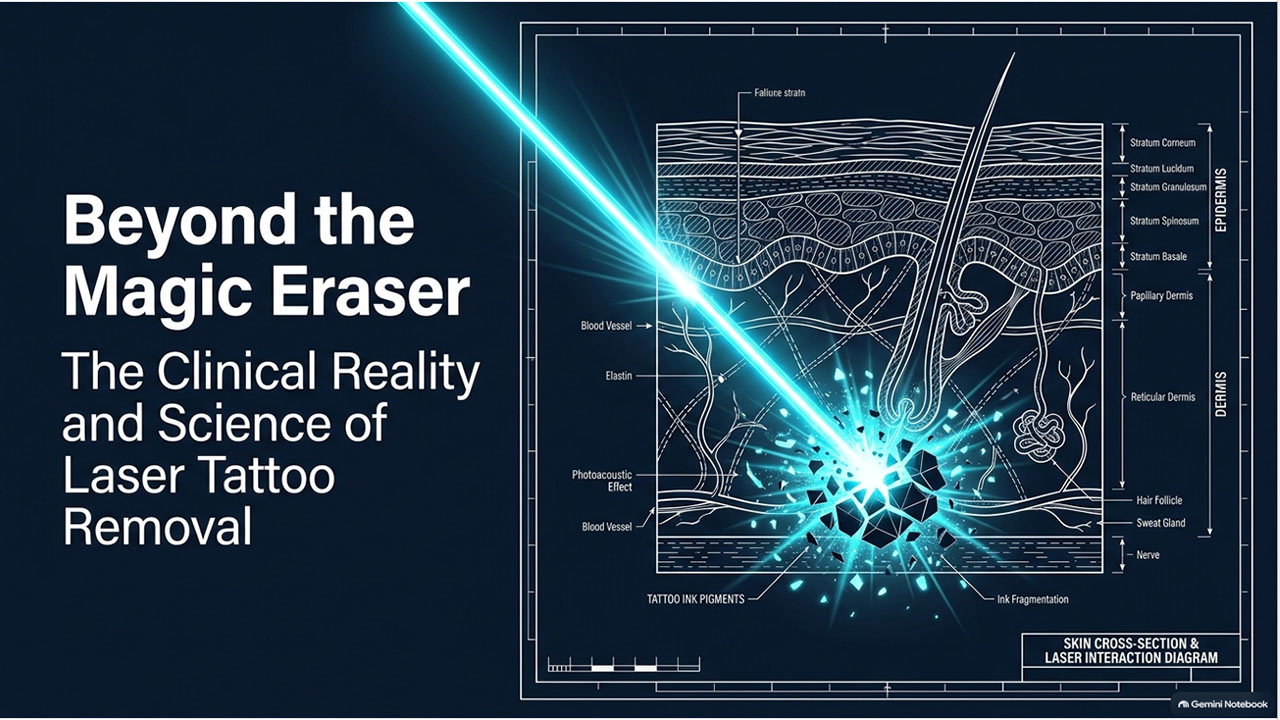
Download PDF File: The Science of Tattoo Removal: How Ink, Skin, and Biology Dictate Fading
Laser tattoo removal has advanced considerably, making it possible to significantly fade or completely remove many unwanted tattoos. However, one of the most important questions patients ask is whether their particular tattoo can disappear entirely.
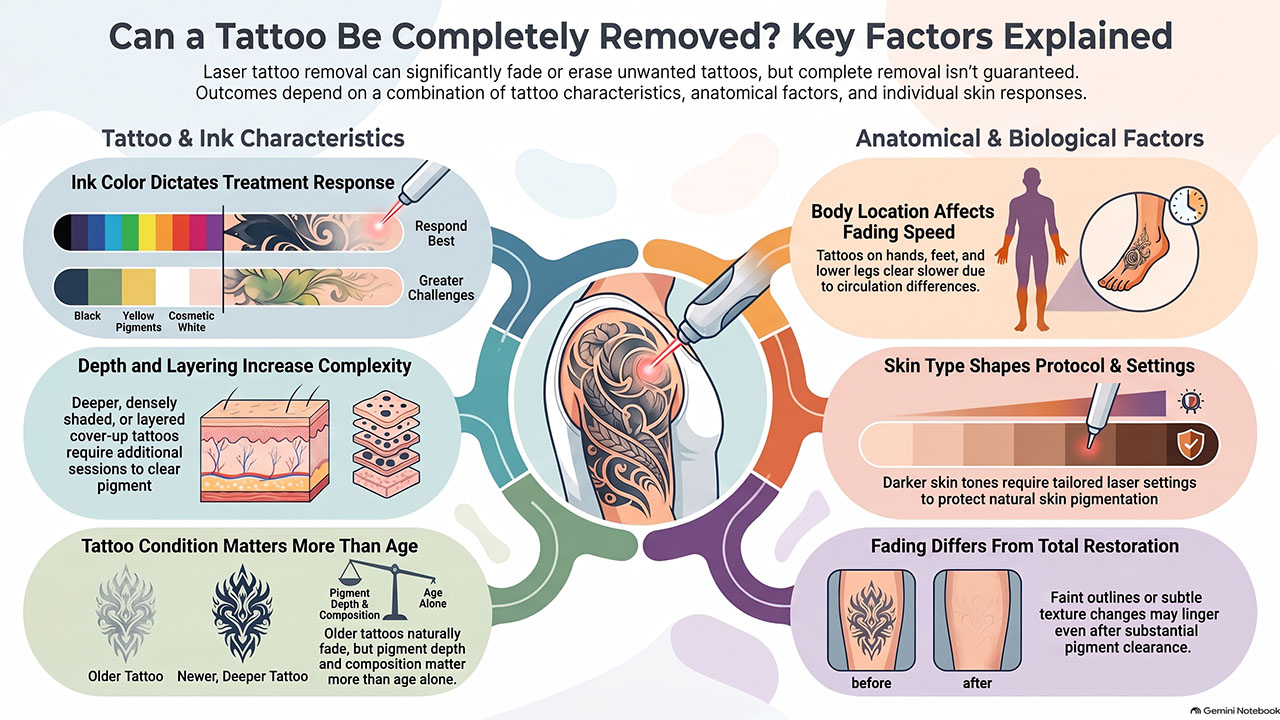
Complete laser tattoo removal is possible in some cases, but the outcome depends on the tattoo’s ink colors, pigment density, depth, location, skin characteristics, and individual response to treatment. Even with modern laser technology, some tattoos retain visible pigment after multiple sessions.
Understanding these factors helps patients develop realistic expectations and make informed decisions about tattoo removal.
Why Are Some Tattoos Easier to Remove Than Others?
Every tattoo is different. Two tattoos that appear similar on the surface may respond differently to laser treatment because of variations in ink composition, pigment concentration, and the way the ink was deposited.
Professional tattoos often contain substantial amounts of pigment distributed throughout the dermis, the deeper layer of skin. Amateur tattoos may contain less ink, but their pigment can be deposited at inconsistent depths.
The amount of pigment present influences how much treatment may be necessary. Tattoos with heavy shading, dense outlines, or multiple layers can require additional sessions.
Successful removal is therefore not determined by tattoo size alone. The characteristics of the pigment beneath the skin are equally important.
Does Tattoo Ink Color Affect Complete Removal?
Tattoo color is one of the most significant factors affecting laser removal.
Black and dark blue pigments generally respond well to appropriate laser wavelengths because they absorb light effectively. Other colors, including certain greens, yellows, and reds, can be more challenging.
Multicolored tattoos may require different laser wavelengths to address individual pigments. Even within a single color, differences in chemical composition can influence treatment response.
White, flesh-colored, and certain cosmetic tattoo pigments present additional challenges because some can darken when exposed to laser energy.
Consequently, a tattoo containing several colors may fade unevenly, with some portions becoming less visible before others.
How Does Tattoo Ink Depth Influence Removal?
Tattoo pigment is deposited in the dermis, where it remains relatively stable over time.
However, not all tattoo artists deposit ink at precisely the same depth. Differences in technique, needle pressure, and repeated applications can produce variations in pigment distribution.
Deeper or densely concentrated ink may be more difficult to clear because laser energy must reach the pigment while minimizing injury to surrounding tissue.
A tattoo that has been repeatedly outlined, shaded, or covered with additional artwork may contain multiple layers of pigment.
These characteristics can complicate removal and make the final outcome less predictable.
Are Older Tattoos Easier to Remove?
Tattoo age can influence treatment response, although older tattoos are not automatically easier to remove.
Over time, some tattoos naturally fade as pigment particles are gradually redistributed or cleared by the body. An older tattoo that has already lost considerable pigment may require less treatment than a newer tattoo with dense coloration.
However, tattoo age is only one consideration.
An older tattoo with deeply deposited ink, multiple colors, or extensive pigment layering may remain difficult to remove.
Similarly, a relatively new tattoo with favorable pigment characteristics may respond well once the skin has fully healed and treatment is appropriate.
The condition of the tattoo matters more than its age alone.
Does Tattoo Location Affect Removal Results?
The location of a tattoo can also influence its response to laser treatment.
Tattoo removal depends partly on the body’s ability to process fragmented pigment. Differences in circulation and tissue characteristics may contribute to variations in fading.
Some tattoos located on the hands, feet, or lower legs can be more resistant to treatment than tattoos elsewhere on the body.
Location should therefore be considered alongside pigment color, density, skin condition, and other individual factors.
No single location guarantees successful removal or predicts treatment failure.
Can Skin Type Affect Complete Tattoo Removal?
Skin characteristics are important when planning laser tattoo removal.
Laser energy must target tattoo pigment while limiting unwanted effects on surrounding skin. Natural skin pigmentation influences the selection of treatment settings and wavelengths.
Patients with darker skin tones may require additional precautions to reduce the risk of changes in skin pigmentation.
Existing scars, previous skin injuries, and a history of abnormal scarring can also affect treatment decisions.
Although laser tattoo removal can be performed on a range of skin types, the treatment approach should be individualized.
A professional evaluation helps determine appropriate expectations and identify potential risks.
Why Do Some Tattoos Leave Pigment Behind?
A tattoo may become substantially lighter without disappearing completely.
Residual pigment can remain when certain ink colors respond poorly, pigment is distributed unevenly, or additional laser treatment would increase the risk of skin damage.
Sometimes a faint outline, shadow, or isolated areas of color remain after numerous sessions.
Skin texture changes or pigmentation differences may also make the treated area appear different from the surrounding skin, even when much of the original tattoo ink has cleared.
This distinction is important: removing visible pigment and restoring the skin to its exact pre-tattoo appearance are not necessarily the same outcome.
How Many Laser Treatments Are Needed for Complete Removal?
There is no universal number of treatments that guarantees complete tattoo removal.
Some tattoos respond relatively quickly, while others require numerous sessions over an extended period.
Treatment planning depends on the tattoo’s size, color, pigment concentration, location, and the individual’s response.
Appointments are typically separated by several weeks or longer to allow skin recovery and continued pigment clearance.
Additional sessions do not always produce proportionally greater improvement. As a tattoo fades, remaining pigment may become increasingly resistant to treatment.
Patients should understand that treatment estimates are approximate rather than guarantees.
Can Laser Tattoo Removal Be Successful Without Complete Removal?
Yes. Successful tattoo removal does not always require the complete disappearance of every pigment particle.
For some patients, substantial fading is sufficient to make an unwanted tattoo much less noticeable. Others seek enough lightening to prepare the area for new tattoo artwork.
The appropriate goal depends on individual preferences, tattoo characteristics, and the risks associated with further treatment.
A realistic treatment plan balances the desired cosmetic improvement with the importance of protecting the surrounding skin.
Evaluating Laser Tattoo Removal in Santa Rosa, California
For individuals considering laser tattoo removal in Santa Rosa and the surrounding Sonoma County area, understanding the factors that influence treatment outcomes is an important first step.
North Bay Laser & Skin Care Center provides laser tattoo removal services for patients seeking to reduce the appearance of unwanted tattoos.
Before beginning treatment, patients should discuss their tattoo characteristics, medical history, expected results, possible side effects, and the likelihood of residual pigment.
The most useful question is not simply whether a tattoo can be removed, but what degree of improvement may be realistic for that particular tattoo.
Understanding the Possibilities and Limitations of Complete Tattoo Removal
Modern laser technology offers meaningful opportunities for removing or substantially fading unwanted tattoos. Nevertheless, complete removal cannot be guaranteed.
Ink composition, pigment depth, tattoo age, location, skin characteristics, and individual healing responses all influence the final outcome.
By understanding these factors and obtaining a professional assessment, patients can approach laser tattoo removal with informed expectations and a clearer understanding of their treatment options.
Schedule a consultation today!
Educational References
The following resources provide additional information about laser tattoo removal, treatment considerations, and expected results.