Laser hair removal is a popular method for reducing unwanted hair, but one of the most common questions patients have is whether treated hair can eventually grow back. Although laser hair removal can produce significant, long-lasting hair reduction, it does not guarantee that every treated hair follicle will stop producing hair permanently.
Hair regrowth after laser hair removal can occur for several reasons, including the natural hair growth cycle, differences in follicle activity, hormonal influences, and individual responses to treatment. Understanding these factors helps explain why multiple sessions are necessary and why some patients benefit from occasional maintenance treatments.
Why Does Hair Grow Back After Laser Hair Removal?
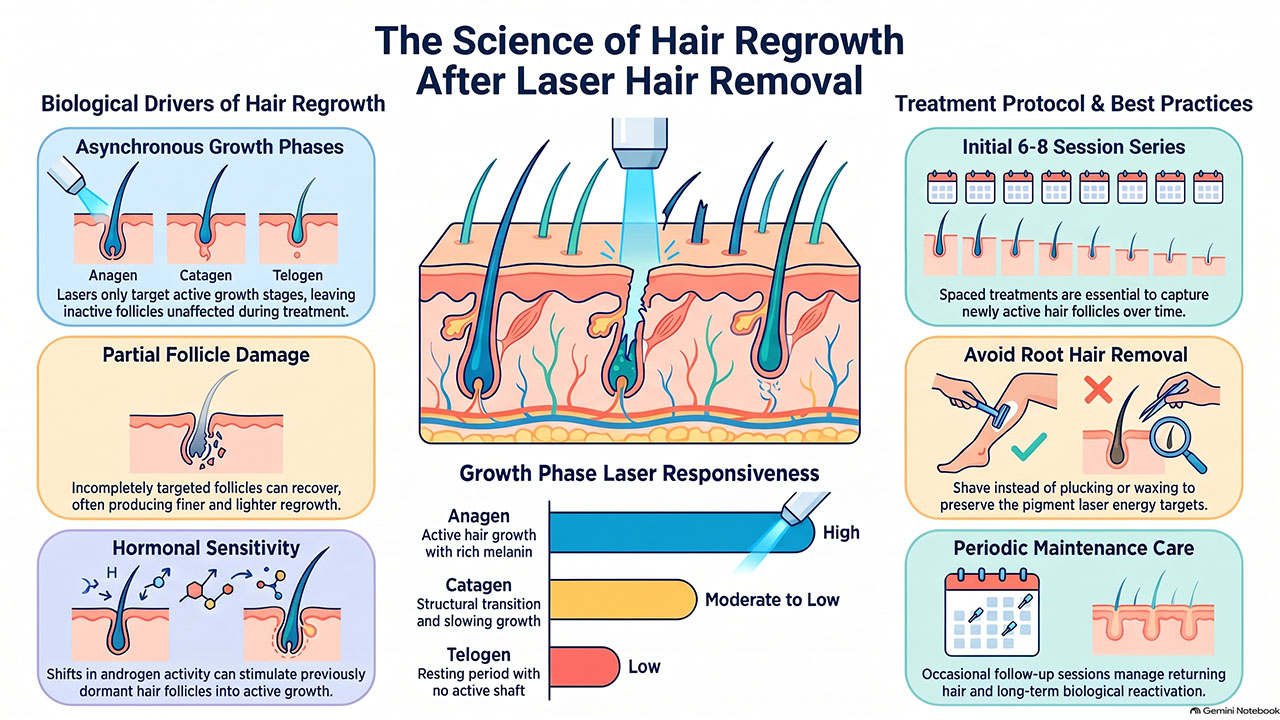
Hair can grow back after laser hair removal because not every hair follicle is permanently disabled during treatment. Laser energy targets melanin, the pigment found in hair, and converts that energy into heat that can damage the structures responsible for hair production.
However, the effectiveness of this process depends on several factors. Some follicles may not receive enough thermal energy to produce lasting damage, while others may be inactive during treatment and become more responsive during subsequent sessions.
When regrowth occurs, the returning hair may be finer, lighter, or less dense than before treatment. The degree of reduction varies among individuals and treatment areas.
Importantly, hair regrowth does not necessarily mean that laser hair removal has failed. It may reflect the biological limitations of treating hair follicles at different stages of their growth cycles.
How Do Hair Growth Cycles Affect Laser Hair Removal Results?
Human hair grows through a repeating biological cycle consisting of several distinct phases. Understanding these phases is essential to explaining why laser hair removal requires multiple treatments.
The Anagen Phase: Active Hair Growth
The anagen phase is the active growth stage, during which the hair shaft develops within the follicle.
Laser hair removal is generally most effective when hair is in this phase because the actively growing, pigmented hair provides an effective target for laser energy.
Not all follicles are in anagen simultaneously, which means a single treatment cannot effectively target every hair in a particular area.
The Catagen Phase: Transition
During the catagen phase, hair growth slows and the follicle undergoes structural changes as it transitions away from active growth.
Hair in this phase may respond less effectively to laser treatment because the structures associated with active hair production are changing.
The Telogen Phase: Resting
The telogen phase is a resting period during which the follicle is not actively producing a growing hair shaft.
Follicles in this stage may be less responsive to treatment. When they subsequently return to active growth, new hair can become visible.
This variation in follicle activity is one of the primary reasons laser hair removal sessions are spaced over several weeks.
Can Hair Follicles Recover After Laser Hair Removal?
Some hair follicles may retain enough functional tissue to resume hair production after laser treatment.
Laser hair removal works through selective photothermolysis, a process in which light energy is absorbed by pigment and converted into heat. The objective is to damage the follicular structures involved in hair growth while limiting injury to surrounding skin.
When sufficient damage occurs, a follicle may lose its ability to produce a visible hair for an extended period or permanently.
However, follicles that receive incomplete thermal damage may continue producing hair. In some cases, the resulting hair is thinner or less pigmented.
This distinction helps explain why laser hair removal is more accurately described as a method of long-term hair reduction rather than a guarantee of complete, permanent hair elimination.
How Do Hormones Influence Hair Regrowth After Laser Treatment?
Hormonal activity can significantly influence hair growth, particularly in areas such as the face, chin, neck, and other hormone-sensitive regions.
Androgens, a group of hormones that includes testosterone, influence the development and activity of certain hair follicles.
Changes in hormonal activity may stimulate follicles that previously produced little or no visible hair. This can occur during periods of hormonal change or in association with conditions such as polycystic ovary syndrome (PCOS).
As a result, new hair growth may appear in an area that previously responded well to laser treatment.
It is important to distinguish between a previously treated follicle resuming hair production and a different follicle becoming active because of hormonal influences.
Patients experiencing substantial or unexpected hair growth may benefit from discussing possible hormonal factors with a qualified healthcare professional.
Why Does Hair Regrowth Vary Between Different Body Areas?
Hair follicles do not behave identically throughout the body. Their growth cycles, density, pigment concentration, and hormonal sensitivity vary depending on their location.
For example, facial hair may be more strongly influenced by hormonal activity than hair on the lower legs. Consequently, facial treatments may require ongoing maintenance for some individuals.
Hair on the legs, underarms, and bikini area may respond differently because of variations in hair thickness, follicle characteristics, and growth patterns.
These differences mean that treatment schedules and long-term results should be evaluated according to the specific body area rather than assuming that every region will respond in the same way.
Does Hair That Grows Back Become Thinner or Lighter?
Hair that returns after laser hair removal is often finer or less dense, although this is not guaranteed.
When treatment partially damages a follicle, its ability to produce a thick, pigmented hair may be reduced.
As a result, patients may notice that returning hair is softer, thinner, or less noticeable than the original growth.
However, finer and lighter hair can also become more difficult to treat because laser hair removal depends on sufficient pigment to absorb the laser energy.
White, gray, and very light blond hairs generally respond poorly to conventional pigment-targeting laser hair removal.
In uncommon cases, laser treatment can be associated with increased hair growth, a phenomenon known as paradoxical hypertrichosis. This is reported more often in certain facial and neck treatment circumstances.
How Many Laser Hair Removal Sessions Are Needed for Long-Term Results?
Most patients require a series of treatments because hair follicles enter their active growth phases at different times.
A commonly recommended initial course involves approximately six to eight sessions, although the appropriate number can vary considerably.
Treatment intervals depend on the body area, individual hair growth patterns, equipment used, and professional assessment.
Some patients notice visible reduction after their first few sessions, while others require additional treatments before achieving their desired results.
The objective is cumulative reduction in hair growth as different groups of follicles become responsive to treatment over time.
A personalized treatment plan is generally more useful than assuming that every patient will achieve the same outcome after a predetermined number of appointments.
Are Maintenance Treatments Necessary After Laser Hair Removal?
Maintenance treatments can help manage hair that returns following an initial series of laser hair removal sessions.
Some patients experience long periods of reduced hair growth without additional treatment. Others may notice gradual regrowth and choose periodic follow-up sessions.
The need for maintenance depends on several factors, including hormonal influences, the original characteristics of the hair, the treated area, and the degree of reduction achieved.
Maintenance treatments are not necessarily evidence that the original treatment was unsuccessful. They can be part of a long-term approach to managing unwanted hair.
How Can Patients Improve Their Long-Term Laser Hair Removal Results?
Several practical steps can help patients follow an effective treatment plan.
Maintain recommended treatment intervals. Attending sessions according to professional guidance allows different groups of actively growing hairs to be treated over time.
Avoid removing hair from the root between appointments. Waxing, plucking, and similar methods can remove the pigmented hair that laser energy needs to target. Shaving is generally permitted according to the provider’s instructions.
Follow sun-exposure precautions. Tanned or recently sun-exposed skin may increase the risk of adverse effects and influence treatment scheduling.
Communicate changes in hair growth. Significant changes in hair density, distribution, or texture may indicate that the treatment plan needs reassessment.
Maintain realistic expectations. Laser hair removal is intended to achieve lasting reduction, but the amount and duration of reduction vary from person to person.
Understanding Laser Hair Removal in Santa Rosa, California
For individuals considering laser hair removal in Santa Rosa, understanding the biological reasons behind hair regrowth is an important part of making an informed treatment decision.
At North Bay Laser & Skin Care Center, laser hair removal consultations provide an opportunity to discuss individual treatment goals, hair characteristics, skin considerations, and realistic expectations.
Because follicles respond differently depending on their growth stage and individual characteristics, successful treatment planning requires more than simply targeting visible hair during a single appointment.
Patients who understand the relationship between follicle activity, treatment timing, and long-term reduction are better prepared to evaluate their results and determine whether additional sessions may be appropriate.
Final Thoughts: Why Hair Regrowth Does Not Always Mean Treatment Failure
Hair regrowth after laser hair removal is influenced by the natural hair growth cycle, incomplete follicle damage, hormonal activity, and differences between treatment areas.
Although laser technology can produce substantial and lasting reductions in unwanted hair, it cannot guarantee that every follicle will remain permanently inactive.
Understanding these biological factors explains why multiple sessions are necessary, why results differ among individuals, and why occasional maintenance treatments may be beneficial.
For patients seeking long-term hair reduction, the most useful approach combines realistic expectations, appropriate treatment planning, and professional evaluation.
Frequently Asked Questions
- Why is my hair growing back after laser hair removal?
Hair may grow back because some follicles were not permanently disabled, were less responsive during treatment, or became active later. Hormonal influences can also stimulate additional hair growth. Regrowth does not necessarily indicate treatment failure.
- Can hair grow back years after laser hair removal?
Yes. Some individuals experience regrowth months or years after completing treatment. Hormonal changes, previously inactive follicles, and incomplete follicle damage may contribute. The amount of regrowth varies, and maintenance treatments may help manage it.
- Does laser hair removal permanently destroy hair follicles?
Laser hair removal can permanently impair some follicles, but it does not reliably eliminate every follicle in a treated area. The treatment is generally described as providing long-term or permanent hair reduction rather than guaranteed complete hair removal.
- Why does facial hair grow back more often after laser treatment?
Facial hair can be particularly sensitive to hormonal influences. Changes in androgen activity may stimulate additional follicles, making ongoing maintenance more likely for some patients.
- Is it normal to need more laser hair removal sessions after completing treatment?
Yes. Additional sessions may be appropriate when residual or returning hair becomes noticeable. The need for further treatment depends on the body area, individual response, and long-term hair growth patterns.