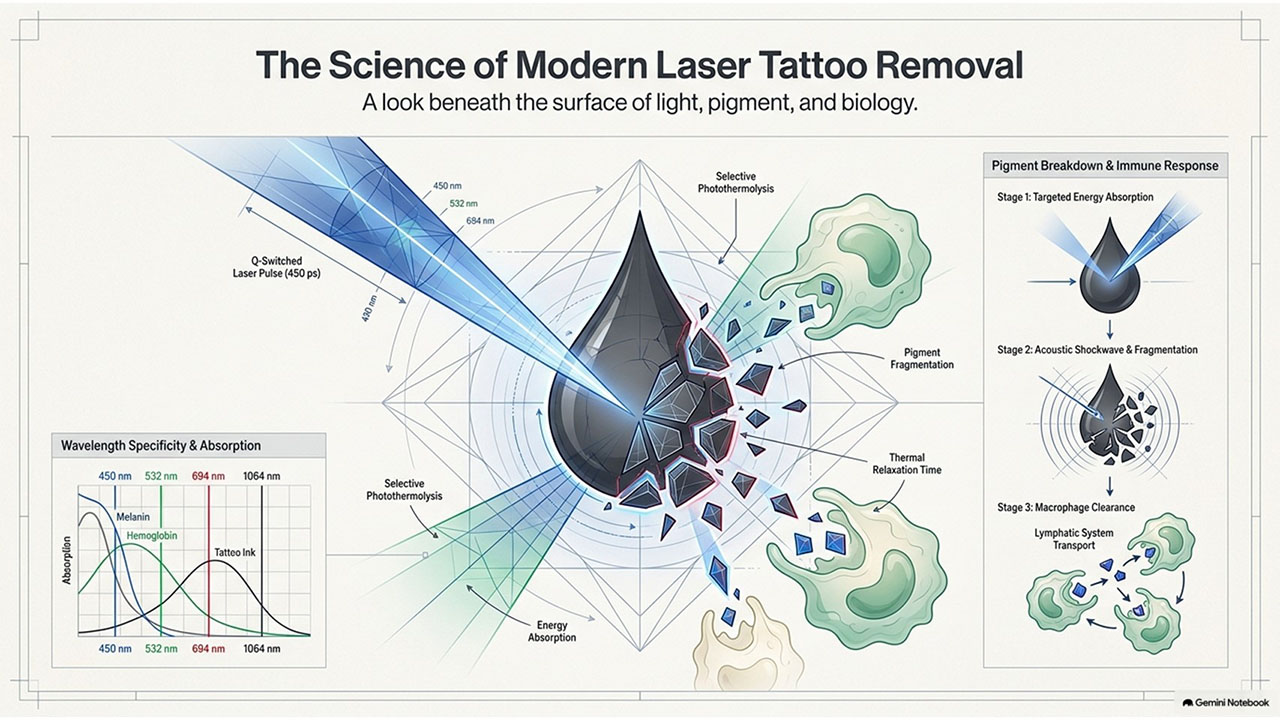
A tattoo may appear to be a permanent image resting quietly beneath the surface of the skin, but what makes tattoo ink remain visible for years is a fascinating interaction between pigment, skin tissue, and the body’s immune system. Modern laser tattoo removal works by taking advantage of that interaction.
Rather than physically removing tattooed skin, today’s laser technology delivers carefully controlled pulses of energy into tattoo pigment. That energy breaks larger ink particles into much smaller fragments, allowing the body’s natural processes to gradually clear them.
Understanding this process helps explain why laser tattoo removal usually requires multiple treatments, why different ink colors can respond differently, and why patience is an important part of achieving successful fading.
Why Tattoo Ink Remains in the Skin
When a tattoo is created, pigment is deposited beneath the outermost layer of skin and into the dermis. This placement is one reason tattoos can remain visible even as the surface of the skin continually renews itself.
The body recognizes tattoo pigment as foreign material and attempts to remove it. However, many of the pigment particles are too large to be efficiently cleared. Immune cells can surround and interact with these particles, but much of the pigment remains trapped within the skin.
That persistence is what gives a tattoo its longevity.
Laser tattoo removal changes the equation by reducing the size of those pigment particles.
How Laser Energy Interacts With Tattoo Pigment
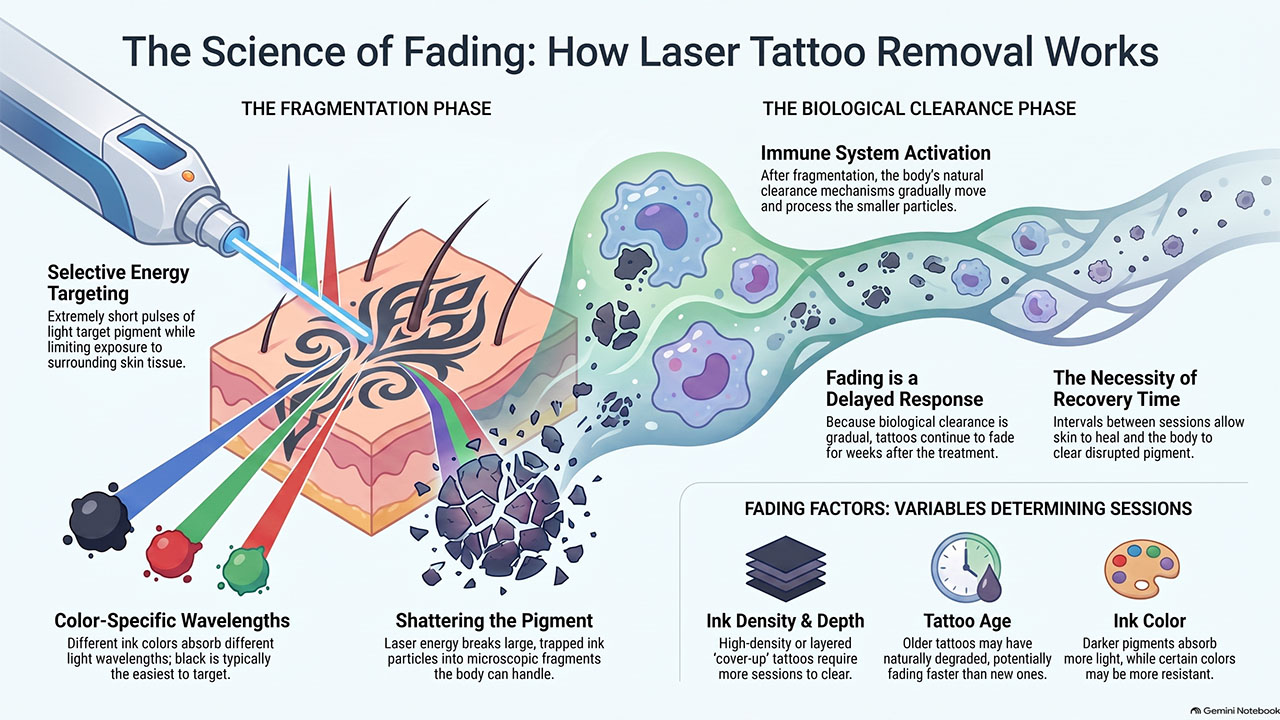
Modern tattoo removal systems are designed to deliver extremely short pulses of laser energy. The goal is to direct that energy toward the tattoo pigment while limiting unnecessary exposure to the surrounding tissue.
Tattoo pigments absorb particular wavelengths of light. When an appropriate wavelength reaches the targeted pigment, the absorbed energy produces a rapid physical effect within the ink particles.
Instead of attempting to erase the tattoo in a single treatment, the laser fragments portions of the pigment into progressively smaller particles.
This principle of selectively targeting pigment is one of the foundations of modern laser treatment.
The wavelength, pulse characteristics, energy settings, tattoo color, pigment density, and characteristics of the patient’s skin can all influence the treatment approach.
The Importance of Wavelength Selection
Not every tattoo pigment responds identically to the same wavelength.
Dark pigments, particularly black ink, tend to absorb a broad range of light and often respond well to laser treatment. Other colors can require wavelengths that interact more effectively with their particular pigments.
This is why tattoo removal is more sophisticated than simply directing a powerful laser at the tattoo.
The objective is to create an effective interaction between the laser wavelength and the pigment being treated.
Professional evaluation is especially important for multicolored tattoos because several pigments may be present within the same design. Even inks that appear visually similar can contain different chemical formulations and may respond differently during treatment.
What Happens After the Laser Treatment?
The laser performs an important part of tattoo removal, but the body performs another.
Once laser energy has fragmented some of the tattoo pigment, the body’s natural clearance mechanisms begin processing the smaller particles. This occurs gradually rather than immediately.
For this reason, a tattoo can continue fading during the weeks following a treatment session.
The process also explains why laser tattoo removal treatments are normally spaced apart. The skin needs time to recover, and the body needs time to respond to the pigment that has been disrupted.
Treating the area more frequently does not necessarily mean the tattoo will disappear proportionately faster. An appropriate treatment schedule allows laser technology and biological clearance to work together.
Why Multiple Laser Tattoo Removal Sessions Are Usually Necessary
One of the most common questions about laser tattoo removal is why a tattoo cannot simply be removed during a single appointment.
There are several reasons.
A tattoo can contain substantial amounts of pigment at different depths within the skin. Attempting to deliver enough energy to address all of that pigment at once would not represent the controlled, progressive approach used in professional laser treatment.
Instead, each session targets a portion of the remaining pigment. As the tattoo becomes lighter, subsequent treatments continue the process.
The number of sessions required varies considerably.
Tattoo age, size, location, color, ink density, layering, professional versus amateur application, skin characteristics, and individual biological response can all affect how quickly a tattoo fades.
For these reasons, responsible laser tattoo removal should be viewed as a treatment process rather than a one-time procedure.
Why Some Tattoos Fade Faster Than Others
Two people with apparently similar tattoos can experience different rates of fading.
An older tattoo may have already undergone years of natural pigment degradation. A heavily saturated professional tattoo may contain significantly more pigment than a lightly applied amateur tattoo. A cover-up can contain multiple layers of ink deposited at different times.
Tattoo location can matter as well because biological clearance is part of the removal process.
Even different areas within the same tattoo may fade at different rates.
This variation does not necessarily indicate that treatment is ineffective. It reflects the complexity of the tattoo itself and the interaction between laser energy, pigment, skin, and the body’s response.
The Difference Between Fading and Complete Removal
The term “tattoo removal” can sometimes create the expectation that every tattoo will disappear completely.
Laser treatment can produce substantial fading and, in many cases, very significant clearance. However, the final result depends on the characteristics of the tattoo and the individual being treated.
Certain pigments can be more resistant than others. Dense or layered tattoos may require additional treatments. Some people are also interested in fading a tattoo sufficiently for a new tattoo or cover-up rather than attempting complete removal.
A professional consultation can help establish realistic expectations before treatment begins.
Protecting the Surrounding Skin
Precision is an essential part of modern laser tattoo removal.
The goal is not simply to deliver energy to the skin. It is to create an interaction with tattoo pigment while carefully managing the treatment of the surrounding area.
This is one reason professional assessment, appropriate laser technology, treatment parameters, aftercare, and adequate intervals between sessions are important.
Patients should also follow the aftercare instructions provided by their laser treatment professional. Protecting the treated area while it heals can be an important part of the overall treatment process.
A More Scientific Approach to Tattoo Removal
Laser tattoo removal demonstrates how modern technology can work with the body’s own biological processes.
The laser does not simply “burn away” a tattoo, nor does the ink instantly vanish when exposed to laser light. Instead, carefully selected laser energy interacts with pigment, fragments portions of the tattoo ink, and creates particles that the body can more effectively process over time.
Each treatment becomes another stage in that gradual process.
Understanding this relationship between light, pigment, and biological clearance makes it easier to understand why treatment plans are individualized and why successful tattoo removal requires both precision and patience.
Frequently Asked Questions About Laser Tattoo Removal
How does laser tattoo removal actually remove tattoo ink?
Laser tattoo removal uses carefully controlled pulses of light energy that are absorbed by tattoo pigment. This energy fragments larger ink particles into smaller pieces. The body’s natural clearance processes can then gradually remove some of these smaller pigment particles, causing the tattoo to fade over time.
Why does laser tattoo removal require multiple treatments?
Tattoo pigment exists at different depths and densities within the skin, and only a portion of the ink can be effectively targeted during each treatment. After a session, the body also needs time to process fragmented pigment and the treated skin needs time to recover. Multiple sessions allow the tattoo to be progressively faded rather than attempting to remove all of the pigment at once.
Are some tattoo colors more difficult to remove than others?
Yes. Tattoo pigments absorb different wavelengths of light, which means individual colors can respond differently to laser treatment. Black and other dark inks often respond well because they absorb a broad range of light, while certain colored pigments may require different wavelengths or may be more resistant to treatment. The composition and density of the ink can also influence the response.
What happens to tattoo ink after laser treatment?
The ink does not simply disappear when the laser reaches it. Laser energy breaks portions of the tattoo pigment into smaller particles. The body’s immune and clearance processes then gradually process these fragmented particles during the weeks following treatment. This biological response is one reason tattoo fading can continue well after the laser session itself.
Laser Tattoo Removal at North Bay Laser & Skin Care Center
At North Bay Laser & Skin Care Center, laser tattoo removal begins with evaluating the tattoo and developing an appropriate treatment approach based on its individual characteristics.
Tattoo color, density, age, location, previous treatments, and the desired degree of fading can all be considered when discussing a treatment plan.
For patients in Santa Rosa and throughout Sonoma County who are considering laser tattoo removal, understanding the science behind the procedure is an important first step. Modern laser technology provides a precise method for targeting unwanted tattoo pigment while allowing the body’s natural clearance processes to participate in the gradual fading that follows.
Tattoo removal is ultimately not a single event. It is a carefully managed interaction between laser energy, tattoo pigment, skin, and the body’s own biological response—and understanding that process can help patients approach treatment with informed and realistic expectations.